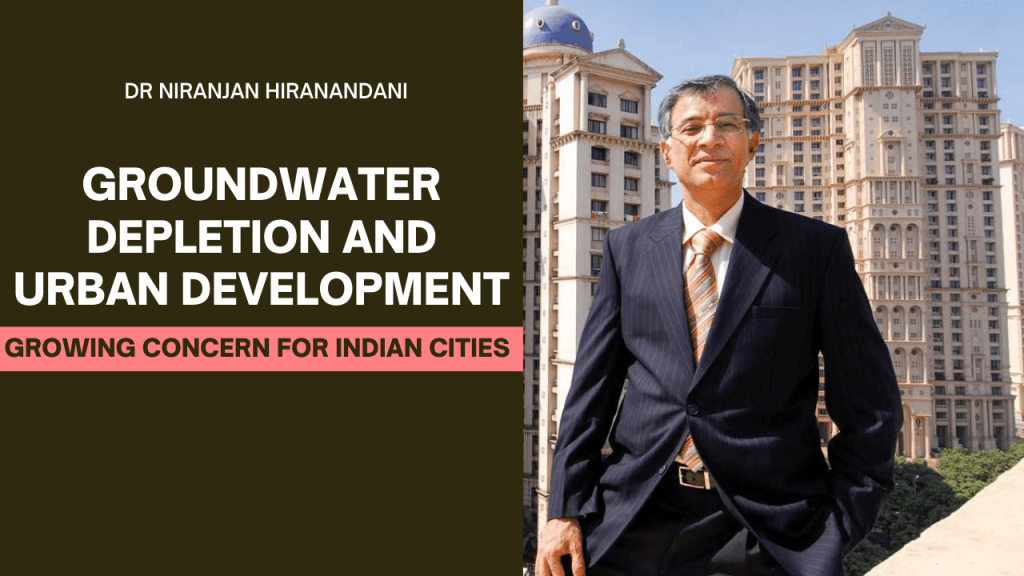
India’s urban landscape has evolved rapidly over the years. Metro connectivity, elevated roadways, emerging business districts, and integrated townships have significantly shaped how cities function today. Real estate has been central to this transformation. However, alongside visible progress, several challenges have surfaced that require serious attention.
Urban growth has largely concentrated around metro cities, positioning them as hubs for finance, services, and innovation. Yet, beneath expanding skylines lies a mounting ecological burden. Reduced green cover, polluted water bodies, rising urban temperatures, and stressed aquifers are becoming increasingly evident. Among these issues, groundwater depletion stands out as the most concerning.
For India to remain competitive globally, growth must continue. But development that overlooks ecological damage, especially groundwater depletion creates long-term risks. Sustainable urban development is therefore essential. Addressing groundwater stress without compromising growth requires collaboration among all stakeholders and the creation of strong, focused policies.
Groundwater Stress in Indian Metros: An Emerging Reality
Metro cities such as Mumbai, Delhi, Kolkata, Bangalore, and Chennai are already facing serious groundwater subsidence. Unregulated borewells, ad hoc construction practices, and fragmented urban planning have played a major role in this decline. Factual assessments and satellite data studies indicate that if current practices continue, water scarcity may become unavoidable in the near future.
Urban infrastructure is often planned without adequate consideration of groundwater levels, natural recharge patterns, or soil behavior. When these factors are ignored, long-term issues emerge. Aging structures, poor construction quality, and unauthorized changes further contribute to the problem.
In cities like Mumbai, which are climate-sensitive and coastal, groundwater depletion interacts with sea-level rise, intense monsoons, and soft, compressible soils. This combination increases the risk of flooding, structural cracks, and instability. As a result, groundwater depletion directly influences urban design decisions, highlighting the need for appropriate and informed planning strategies.
Understanding the Economic Impact of Water Scarcity and Waste
Water scarcity also carries an economic dimension. As groundwater availability declines, operational costs increase. Greater reliance on external water sources disrupts local ecosystems and affects the long-term viability of real estate projects.
At the same time, buyers and investors are becoming more informed. Homebuyers increasingly prefer eco-conscious residential developments that support long-term sustainability. Investors are also tracking environmental, social, and governance (ESG) performance, ensuring that capital creates value without generating ecological debt.
Groundwater depletion represents one of the largest ecological debts currently accumulating across Indian cities. From metro regions to emerging districts, groundwater extraction far exceeds natural replenishment. This imbalance threatens not only environmental stability but also the economic sustainability of urban growth.
For these reasons, circular economy principles and low-carbon development must form the backbone of India’s urban strategy. These approaches help reduce groundwater extraction, improve aquifer recharge, and support a built environment aligned with sustainability.
Circular Economy: A Necessary Shift for Groundwater Conservation
Groundwater conservation is not possible without moving away from linear water consumption. Extracting groundwater, using it once, and discharging it into drains leads to irreversible aquifer decline.
Circular approaches reduce pressure on stressed aquifers through treated wastewater reuse, rainwater percolation, stormwater harvesting, and dual plumbing systems.
Key outcomes of these approaches include:
- Every liter of recycled water reducing groundwater extraction
- Every rainwater percolation pit contributing to aquifer recharge
- Every decentralized sewage treatment plant supporting circular water use
- Every low-carbon design reducing environmental stress on water-dependent ecosystems
Together, these elements form the foundation of sustainable urbanization.
Low-Carbon Development and Its Role in Groundwater Stability
Low-carbon urban development supports groundwater stability and complements conservation efforts. It is not separate from groundwater management.
The use of energy-efficient systems, low-embodied carbon materials, and climate-sensitive building designs reduces urban heat stress and improves soil moisture retention. These factors indirectly support groundwater equilibrium.
Urban heat islands and excessive concretization are major contributors to groundwater depletion. Low-carbon planning therefore becomes essential for stabilizing natural recharge cycles and reducing environmental stress on urban ecosystems.
Township-Level Implementation as Proof of Feasibility
Sustainable groundwater strategies are already being implemented within India. Large private townships such as Hiranandani have adopted circular water systems for decades.
These include decentralized sewage treatment plants, stormwater recharge networks, and integrated green landscapes designed to minimize groundwater extraction and stabilize local aquifers. This is not a conceptual framework but an implementation-based example.
If groundwater-sensitive, circular systems can be executed at the scale of a township, similar approaches can be implemented at the city level through coordinated planning and governance. Such practices should become standard rather than exceptions.
Why Groundwater Depletion Must Shape Urban Planning
Groundwater depletion cannot be treated as a secondary concern. It must directly influence how cities are built and expanded.
Declining groundwater levels result in weakened infrastructure, reduced soil stability, increased urban flooding, higher construction risks, rising operational costs, and greater climate vulnerability.
For India’s economic ambitions urban productivity, global competitiveness, and industrial expansion groundwater stability is essential. Sustainable development is not an alternative to growth; it is the prerequisite that enables it.
Conclusion: Growth That Protects Water Resources
India’s urban future depends on how responsibly groundwater resources are managed today. Continued expansion without addressing groundwater depletion will weaken both ecological balance and economic resilience.
Circular water infrastructure, low-carbon urban systems, climate-responsive planning, and strong policy enforcement must be integral to urban development. Cities can grow without exhausting the aquifers beneath them if action is taken now.
FAQs
Why is groundwater depletion a critical issue for Indian cities?
Groundwater depletion affects infrastructure stability, increases flooding risk, raises operating costs, and heightens climate vulnerability.
What urban practices contribute most to groundwater depletion?
Unregulated borewells, fragmented planning, ad hoc construction, excessive concretization, and ignoring recharge patterns are major contributors.
How does the circular economy help address groundwater stress?
Circular systems reduce groundwater extraction through reuse, recharge, and closed-loop water management.
What is the connection between low-carbon development and groundwater?
Low-carbon development reduces heat stress, improves soil moisture retention, and supports groundwater recharge cycles.
Are groundwater-sensitive urban systems achievable in India?
Yes. Existing township-scale implementations show that such systems are practical and scalable.
 Prashant Vermaa Business Blog
Leave a comment